European Parliament VP visits IIAS for Roundtable on European Knowledge Collaboration with the Global South
On 30 January 2026, the International Institute for Asian Studies was honoured to welcome the Vice President of the European Parliament, Mr Younous Omarjee, and his team to Leiden for the productive Roundtable Repositioning Europe’s Knowledge Collaboration with the Global South in a Fast-Changing World (pdf).
The visit to Leiden University represented a meaningful step in strengthening dialogue between the European Parliament and knowledge institutions engaged with the Global South. At a moment of profound geopolitical transformation, creating spaces for open and sustained exchange is not only timely but essential. Having worked for many years to foster such spaces through its events, fellowships, networks, and publications, IIAS was delighted to convene this diverse set of knowledge actors from a range of disciplines and sectors.
Co-moderated by Dr Philippe Peycam (IIAS) and Dr Abena Amoah (LUMC), the Roundtable invited reflections on the shared challenges and opportunities characterising the contemporary moment: How can Europe move beyond traditional North–South frameworks towards genuinely reciprocal partnerships? How can the strategic value of knowledge collaboration be articulated in today’s multipolar and increasingly uncertain world? And what kinds of support do knowledge institutions need from the EU and national governments to advance this critical work of knowledge diplomacy? The event yielded concrete recommendations as well as a common vision for future collaborations. IIAS looks forward to facilitating further meetings in Leiden, Brussels, and Strasbourg, alongside our partners in the Global South and elsewhere in the world.
We extend our sincere thanks to all participants and institutions who contributed to this rich and thoughtful exchange: Leiden University, Leiden University Medical Center, African Studies Centre Leiden, International Institute of Social Studies (ISS) of Erasmus University Rotterdam, TU Delft | Global Initiative, IHS, Institute for Housing and Urban Development Studies of Erasmus University Rotterdam, NWO (Dutch Research Council), The Clingendael Institute, the European Centre for Development Policy Management, KITLV/Royal Netherlands Institute of Southeast Asian and Caribbean Studies, Ministerie van Buitenlandse Zaken (the Ministry of Foreign Affairs), and the Adviesraad Internationale Vraagstukken (AIV).
We are especially grateful to Vice President Omarjee for his strong engagement and for his recognition of knowledge diplomacy as both a tool and a methodology for rethinking Europe’s role in a changing global landscape.
Following the Vice President’s participation in the Roundtable, during his speech at the reception, Mr Omarjee remarked:
“That is why political leaders need you: scholars, researchers, universities — institutions capable of working in the long term, of building bridges, of connecting distant societies. What is emerging here is a true diplomacy of knowledge — a cooperation based on mutual understanding rather than domination, on equality rather than hierarchy.”
This shared aspiration towards knowledge diplomacy underpins IIAS’ mission to nurture collective spaces and facilitate connections. We will continue to work towards trust-based, long-term knowledge partnerships between Europe and the Global South—partnerships that are co-created, multi-centred, and responsive to the challenges and possibilities of our time.
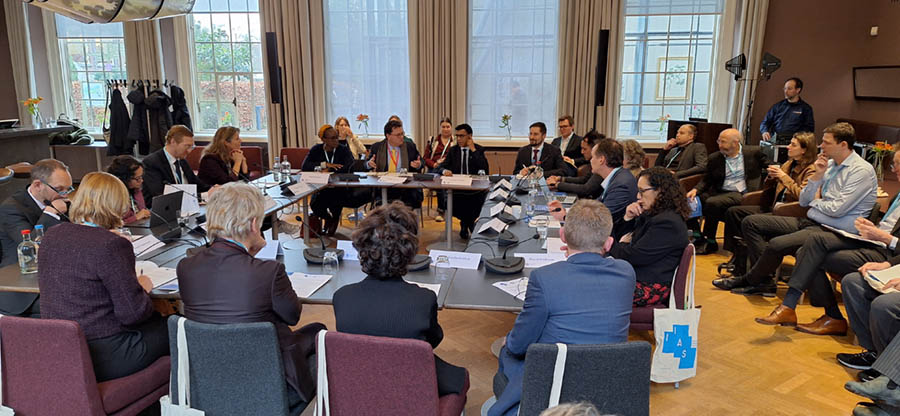
Roundtable at Leiden University Faculty Club. Photo: Sandra Dehue
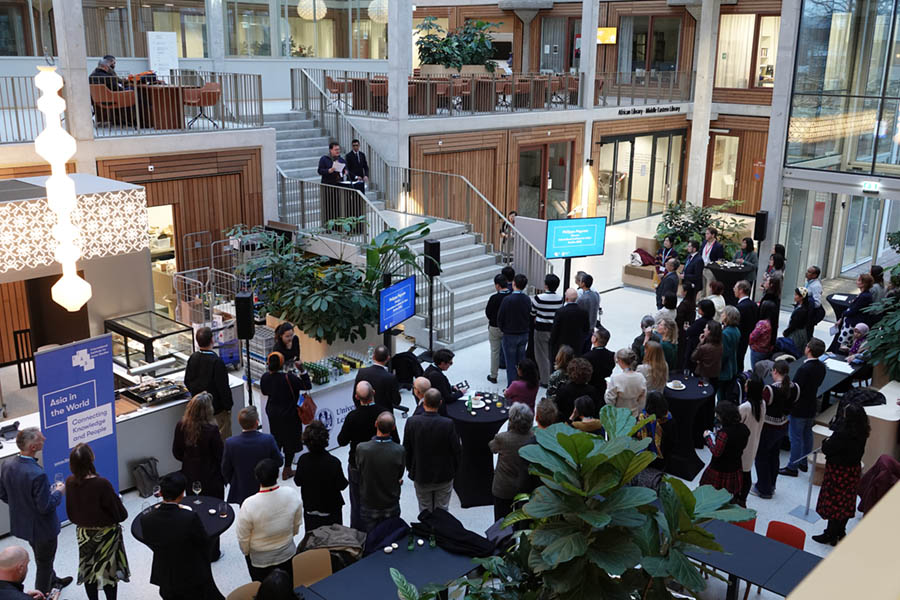
Reception at the IIAS Offices in the Herta Mohr building of Leiden University. Photo: Sandra Dehue
Speech by Vice President Younous Omarjee
It is a particular honor to speak today at Leiden University.
Because this university is not only one of the oldest in Europe. It is a founding place in the European history of knowledge — born from a profoundly political intuition in the noblest sense of the word: that intellectual freedom is inseparable from human freedom, and that knowledge is one of the strongest safeguards against domination, arbitrariness, and violence.
Leiden was also one of the birthplaces of modern international law, with Hugo Grotius — the affirmation that law must stand above power, and that even war must be subject to rules. From its very beginnings, Leiden was a refuge for threatened ideas — a space where science, philosophy, and law could develop without fully submitting to dogma or power. It embodies an essential idea, one that is increasingly fragile today: that knowledge is not a luxury, but a condition of emancipation.
I would like to acknowledge the various research institutes that are present today and the entire knowledge ecosystem. I would like also to extend my special thanks and appreciation to IIAS. I had the honor of speaking at the ConFest in Dakar and I was very impressed by both the method and the number of participants.
⸻
When I accepted the invitation to take part in this event, the world already seemed unstable. In just a few weeks, however, we have witnessed a succession of upheavals that are profoundly reshaping the global landscape. One may even ask whether it is still accurate to speak of an international order.
Repeated violations of international law and of the United Nations Charter — from Ukraine to the Middle East, from Latin America to Africa — the normalization of force, threats made by the world’s leading power against a country and an overseas territory of the European Union: all of this cannot leave us indifferent. Added to this are the new challenges of the digital age and artificial intelligence, the attacks on science — including climate science — and, ultimately, the erosion of truth itself.
These are not isolated or fleeting events. They are the visible expression of a deeper movement. History has never been a straight line. It is made of turning points, ruptures, advances and setbacks. What we are experiencing today is not an anomaly, but the end of the illusion that the world could be indefinitely stabilized.
⸻
In this context, a dangerous narrative is once again gaining ground: the so-called “clash of civilizations.”
This narrative is misleading. What we are witnessing is not a clash of civilizations, but very often a clash of ignorance — a lack of knowledge of others’ histories, trajectories, and aspirations. Conflicts do not arise from too much understanding, but from too little of it.
This is where universities play a decisive role.
Universities are among the few places where young Europeans can learn to understand the world beyond fear, caricature, and domination — where knowledge of others is transmitted on rigorous foundations, on the basis of equality between cultures.
This is why African and Asian studies are not peripheral fields. They are central to understanding the twenty-first century. Africa and Asia are not margins of the world; they are among its main centers — demographically, economically, culturally, politically. Ignoring them means choosing blindness. Studying them seriously means choosing intelligence.
⸻
At the same time, within today’s turmoil, we see the calm but certain emergence of multiple middle powers across Asia, Africa, and Latin America. The world order established after the Second World War is no longer sufficient. The world to come is still being written.
This moment therefore calls on Europe to rethink itself — its project, its place in the world, and its relationship with others. Political action is too often trapped in immediacy, in reaction. That is why political leaders need you: scholars, researchers, universities — institutions capable of working in the long term, of building bridges, of connecting distant societies.
What is emerging here is a true diplomacy of knowledge — cooperation based on understanding rather than domination, on equality rather than hierarchy.
⸻
Retreat into nationalism is a dead end. It threatens our societies, our youth, and our relationship with the world. Against ignorance, we must oppose knowledge. Against prejudice, understanding. Against fear, intelligence.
Universities and research institutes are on the front line of this struggle. Through your work, we can move beyond constant reaction and rediscover long-term thinking.
And this brings me to the essential point.
In a world marked by instability and acceleration, there is one compass we must not lose: knowledge.
Knowledge grounded in rigor.
Intelligence that embraces complexity.
Truth patiently constructed.
Science protected from intimidation.
This is where universalism finds its true meaning — not as uniformity, but as a shared horizon: equality between cultures, dialogue between civilizations, and the recognition that all societies produce knowledge and meaning.
Placing science, intelligence, and truth at the center of our collective future is not idealism. It is realism. It is the most concrete response to disorder and conflict.
Europe still has a role to play. But it must learn to decenter itself, to engage the world with humility and respect.
The EU is currently expanding its partnerships, which is a very good thing. But it must not focus solely on trade. The exchange of knowledge is key. We must open up new dimensions and, in particular, establish a diplomacy of knowledge.
In times of upheaval, the choice is clear:
either we allow ignorance to shape the world,
or we entrust its future to knowledge.
At Leiden University, that choice has already been made. And it remains one of our best hopes for a shared and peaceful future.